View Item 
      •   IPB Repository
      • IPBana
      • Articles
      • Faculty of Fisheries and Marine Science
      • Marine Science And Technology
      • View Item
      •   IPB Repository
      • IPBana
      • Articles
      • Faculty of Fisheries and Marine Science
      • Marine Science And Technology
      • View Item
      JavaScript is disabled for your browser. Some features of this site may not work without it.

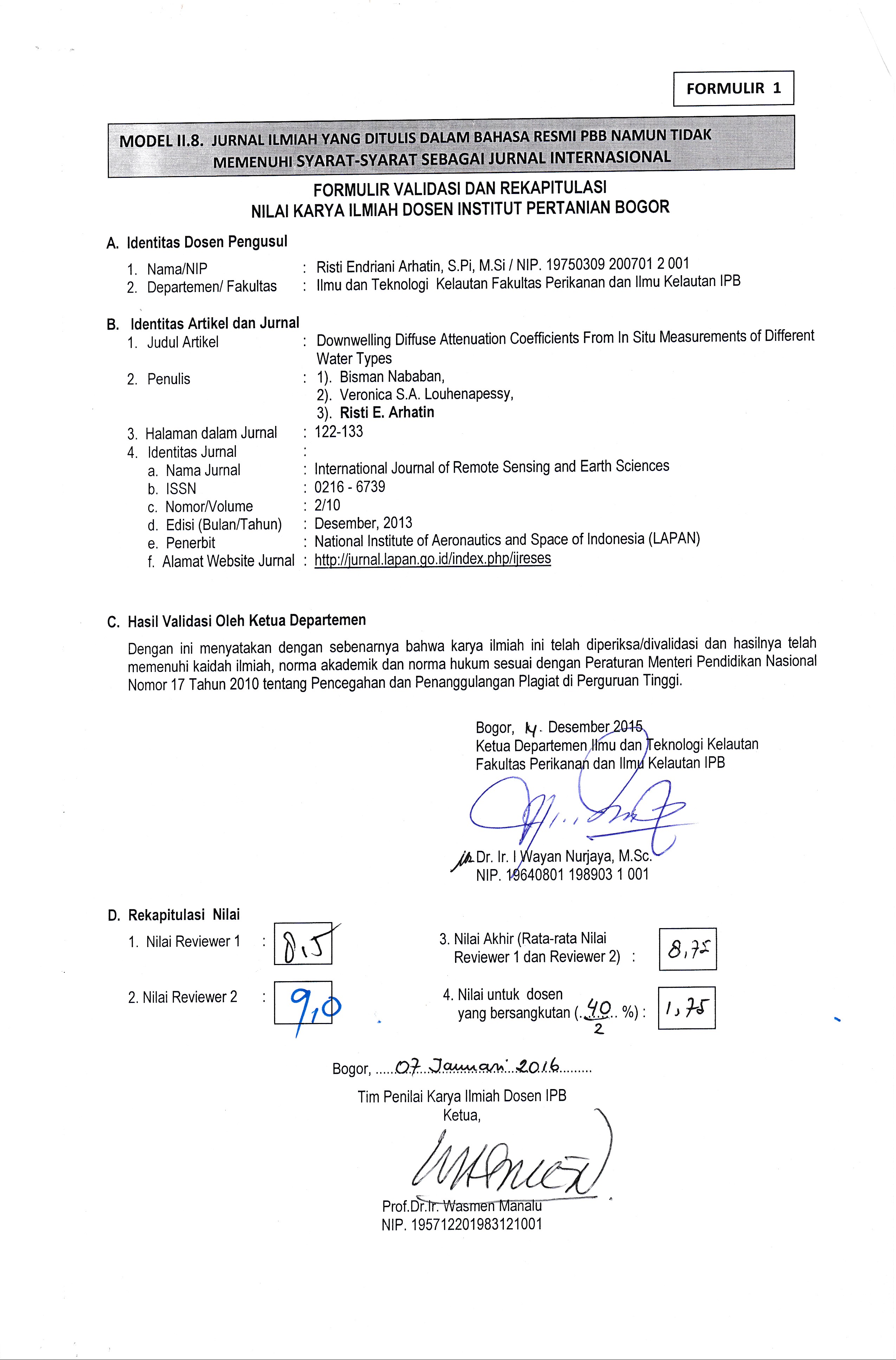
      Downwelling Diffuse Attenuation Coefficients from In Situ Measurements of Different Water Types

      Thumbnail
      View/Open
      Validasi Downwelling Diffuse Attenuation Coefficients from In Situ Measurements of Different Water Types.jpg (1.064Mb)
      Date
      2013-12
      Author
      Nababan, Bisman
      Louhenapessy, Veronica S.A.
      Arhatin, Risti Endriani
      Metadata
      Show full item record
      Abstract
      Process of light reduction or loss (attenuation) by scattering and absorption is affected by solar zenith, time, depth, and seawater constituents. Downwelling diffuse attenuation coefficient (Kd) is important to understand for light penetration and biological processes in ocean ecosystem. It is, therefore, important to know the Kd value and its variability in ocean ecosystem. The objective of this study was to determine downwelling diffuse attenuation coefficients and its variability form in situ measurements of different water types. In situ downwelling irradiances (Ed) were measured using a submersible marine environmental radiometer instrument (MER) during a clear sky, calm water condition, and at the time range of 10:30 a.m. up to 14:00 p.m. local time in the northeastern Gulf of Mexico in April 2000. In general, Ed values decreases exponentially with depth. Ed at 380 nm exhibited the lowest attenuation (the most penetrative light), while Ed at 683 nm exhibited the highest attenuation (the most light loss at the top of water column). Overall, the Kd patterns tended to decrease from 380 nm to 490 nm (blue-green wavelength), and increase from 490 nm to 683 nm (green-red wavelength). Kd values in offshore region were relatively lower than in coastal region. Kd can be used to determine the depth of euphotic zone in offshore or teh case-1 water type and the depth of one optical depth (the water column depth where the ocean color satellite can possibly sense).
      URI
      http://repository.ipb.ac.id/handle/123456789/79103
      Collections
      • Marine Science And Technology [170]

      Copyright © 2020 Library of IPB University
      All rights reserved
      Contact Us | Send Feedback
      Indonesia DSpace Group 
      IPB University Scientific Repository
      UIN Syarif Hidayatullah Institutional Repository
      Universitas Jember Digital Repository


      Browse

      All of IPB RepositoryCollectionsBy Issue DateAuthorsTitlesSubjectsThis CollectionBy Issue DateAuthorsTitlesSubjects

      My Account

      Login

      Application

      google store

      Copyright © 2020 Library of IPB University
      All rights reserved
      Contact Us | Send Feedback
      Indonesia DSpace Group 
      IPB University Scientific Repository
      UIN Syarif Hidayatullah Institutional Repository
      Universitas Jember Digital Repository